Sunday, March 13, 2011

Get Thee to Matrimony - the Single, Working Women's Films of the 1940s

I've been watching some films lately that centre around women and their opportunities in the 1940s. There was quite an influx in this decade (and in the 30s and 50s) of films about working women whose aim is, not for a promotion or a pay rise, but to marry and surrender to family life. Because let's face it, in those days equal pay was not happening, but marriage was always in the market. On the one hand, it endorses women in the workforce, but it does that so long as they are single. Once marriage comes along it's bye bye labour and hello bubs. Of course there are probably variations, but it's just interesting to see how these heroines are often both liberated and confined in what society allows of them.

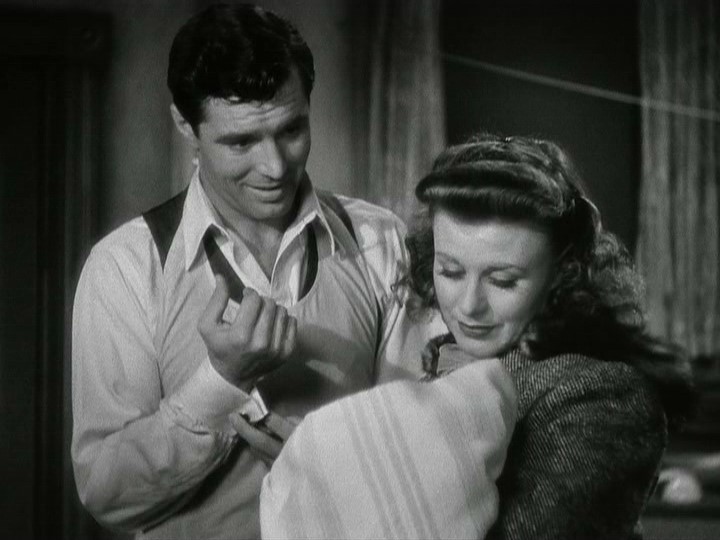
Kitty Foyle (1940) ~ Here you have a toned down, stripped to brown hair color and ultimately Oscar-winning Ginger Rogers in what was arguably her first serious role. It was all about RKO giving her an actress-y vehicle, equipped with notable director Sam Wood (Goodbye Mr. Chips), nice set, costume and hair, and good supporting cast. The film itself is about a gal from a working-class Irish background who falls in love with a rich-bred man (Dennis Morgan) in whose world she ultimately can't fit.

The film begins with a pre-1940s context of what women had to deal with - it shows a woman whose goal in life is to marry well and then shows her in a lavish setting in which her husband works while she's at home. Yet she becomes discontent, sets off for work and joins the women's suffragette.

The plight of Ginger Rogers' Kitty Foyle, and of several working gals of the 30s and 40s, is the somewhat reverse. She starts off as the worker, as the independent gal earning her own income (she herself says "...nobody owes a thing to Kitty Foyle, except Kitty Foyle") for whom marriage is the end of her efforts. Indeed, after reaching the position of manager (or thereabouts) of a perfumerie in Philadelphia, she resigns and marries a doctor. The important thing for her is that she married a man who fits her terms, a man who worked his way up the ranks just as she did (unlike Morgan's character who was born into privilege) and, perhaps, a man through whom she can live out her ideals. It's not quite the feminism of the 70s, indeed it's a bit contradictory and roundabout, but it's a step in that general direction.

Tom, Dick and Harry (1941) ~ Where Kitty Foyle was a drama, here is a comedy about a twenty-something middle-American girl on the quest for Mr. Right. What sets this one apart is that it's quite a fun ride. Ginger plays Janie, a gal who's ready to settle down, but has trouble deciding between three would-be suitors including wealthy Dick (Alan Marshal), ambitious Tom (George Murphy) and humble Harry (Burgess Meredith. Through the film she accepts the engagement of all three and embarks in wild fantasies of what it would be like to be either Mrs. Tom, Dick or Harry. These fantasies are incredibly exaggerated and pretty funny as a result.

The film swims along at a good regular pace, with peppy dialogue that seems to come out naturally, and has good support from Phil Silvers as an icecream vendor and Lenore Lonergan as Janie's rather prying sister 'Butch.' The ending is quite interesting in how it allows Janie to choose romantic love over a marriage that will get her ahead in life. Perhaps one can argue that because her ultimate partner is not the richest fellow in the world, she too will need to work allowing for greater equality between the sexes. Though how long that would last once the babies come along is harder to decipher.

Every Girl Should Be Married (1948) ~ Yet another comedy that shares some notes with the earlier films. Aside from the film's title being a more aggressive indication of what the first two films were ultimately about, you have the twenty-something gal (Betsy Drake) looking for, who was that, why it's Mr. Right. There's a slight deviation however. The first two films are essentially set during the war (there's even a scene in Tom, Dick and Harry where Janie and Tom walk out of the cinema just as a Hitler news reel comes on).

On the other hand, Every Girl Should Be Married is a postwar product. In a way there's a more desperate tone to it perhaps echoing the importance of the nuclear family. Notably, Grant's character Madison is a 'baby doctor (his deprecating words),' who is a staunch bachelor without any intentions of having his own family. The film's goal then is to convert Grant into a reformed family man and for Drake's persistent (and kind of stalkerish) Anabel to conduct the operation.

Otherwise it's an entertaining enough film. To keep it off the beaten track of being tedious too quickly, it's coloured with other characters - you have Franchot Tone as a wealthy guy who Anabel utilises to make Madison jealous, Diana Lynn all grown up (that wise beyond her years youngster from The Major and the Minor and The Miracle of Morgan's Creek) and a cameo from Eddie Albert at the end. Just like Kitty Foyle, Annabel gets the doctor in the end.

Saturday, February 26, 2011

The Director and the Muse

I haven't quite seen every necessary film of these collaborators to really merit this list, but nevertheless I bring to this plate my impressions thus far of these partnerships.

Jean-Luc Godard and Anna Karina - Married at the time of their film collaborations, Karina was key to the most fruitful period of Godard's career - the early to mid 60s. She was the lead in many of Godard's films during this period and she proved to adapt well to the different themes and atmospheres, without forsaking their shared interest in whimsy. She could play the philosophical hooker yearning for fulfillment in her most harrowing role as Nana in Vivre sa vie, but then be joie-de-vivre as the clucky singer in the technicolored Une femme est une femme. One film that showcases her ability to switch the nature of her character is Pierrot le fou, where her seeming childlikeness and sense of adventure mask darker, femme-fatale motives.

Woody Allen and Mia Farrow - The whole scandal aside, Allen and Farrow were quite the creative collaborators during the 80s period in which she was his muse. Woody gave Mia showcases for her sometimes underused talents and she in return is part of the reason why Allen's 80s period has so much breadth and is arguably his most consistent as a filmmaker. I think Allen distinctly understood Farrow's talents and her versatility, and so she pretty much never plays the same role twice in a film of his - whether it be as the Italian broad Tina Vitale in Broadway Danny Rose, the fragile Cecilia in The Purple Rose of Cairo, the surface-happy title character in Hannah and Her Sisters or the likeable ditz who becomes a star in Radio Days.

Martin Scorsese and Robert De Niro - Is it a coincidence that (arguably) De Niro's film roles haven't been quite as good as his glory days with Scorsese in the 70s-early 90s? There's is a partnership of an actor perfectly projecting the director's intentions onto film. The faith towards each other's works (which is crucial to the perfect partnership) can be seen in such films as Taxi Driver, The King of Comedy and De Niro's Oscar winning Raging Bull among others. Many of De Niro's characters under Scorsese are troubled, tumulting into some sort of madness, but always compelling and rendered with sensitivity.

Frank Capra and Jean Arthur - I could have gone with Capra and Stewart, but I really like the dynamics moreso between Capra and Arthur. Arthur fans would know of the often-told story that she was a bundle of nerves on set with more than a fair share of insecurities. According to Capra's son on the Mr. Smith Goes to Washington dvd commentary, Capra didn't mind the challenge that was Arthur's nerves. Indeed getting Arthur to deliver stellar performances was something of an accomplishment. Thus, a trusting director with confidence in an actor's ability can sometimes have the final say between a mediocre and good performance. I wouldn't say that Arthur didn't perform as well with other directors (she certainly delivered well for Stevens and Leisen), but that some of her performances for Capra - especially Mr. Deeds Goes to Town and Mr. Smith Goes to Washington - are at another level of maturity, assuredness and strength, with classic Arthur vulnerability thrown in.

Tuesday, January 4, 2011

Romantic Comedies (of Sorts) That I Unabashedly Adore

It is Valentine's Day, so what better way to celebrate than by revisiting the romcom.

Today the genre 'romantic comedy' carries a bit of a bad rep. It is invariably referred to as the 'chick flick.' Most of the time it's mind-absent entertainment, something to see when you don't want to think. The plot is usually formulaic, the laughter is barely there and usually the set and clothing designs matter more than anything else. So it makes me, who's sort of an obnoxiously exclusive filmbuff of sorts, a bit reluctant to admit I have a fair share of rom-com favourites. Or romantic-drama-com. Here is a post-60s list.

A Touch of Class (1973) ~ I saw this one recently, so how well it holds up on multiple viewings is something I can't comment on. It's not really a classic, and is perhaps more known for its blunders than its positives. In particular there's the maligned Glenda Jackson performance - maligned because she won an Oscar for it. And if you ever get a chance to watch a clip of the 1974 Oscars, you'll see the shocked reactions of Ellen Burstyn and Joanne Woodward when the absent Jackson's name is called. So yeah, people won't happy about it even then. '

Another complaint I've heard is that the film can't make up its mind whether to be a comedy or a drama, so it settles for one half of each [hence the new coined term, romantic-drama-com]. Then there are those who disapprove of the film's lack of morality, since it concerns an affair and sort of brushes over the respective families of either lead. Maybe I'm too easily pleased, but I didn't find any of those factors bothering me.

I think the most essential part of a romantic comedy is how well the leads gel. If the spark isn't there, then there's no way the film can take flight. And it was primarily the interesting dynamic between Glenda Jackson's stiff, feminist Englishwoman and George Segal's mildmannered native New Yorker that made me keep watching. It's a clear 'opposites shouldn't attract but somehow do' dynamic. But another factor I think is primary for this genre is the situations. This film had a nice island-esque backdrop during the second-third which was prime for some funny and revelatory situations. Yes there's a drop in the fire-cracking comedy in the second half, but Jackson and Segal make it work.

The Owl and the Pussycat (1970) ~ Segal again, this time with Barbra Streisand. This one's an early 7os film that exploits the most it can out of the liberal decade that was. It's a sex farce comedy that was risque for its time, and yet still somehow came out charming. Again I think it's the leads. Segal and Streisand make a great contrast, with her as the kooky screwball-type and him as the stiff-shirt type that learns to relax a little. It's definitely a bit of a 'updated' throwback to the screwball comedy of the 30s and 40s, similar to another Streisand comedy What's Up, Doc?

Irma La Douce ~ This film is a tad overlong for its genre, but other than that I don't have complaints. As far as Wilder-Lemmon-MacLaine combinations go, it's unfair to compare it to The Apartment. If there were such a thing as bar fights between films, certainly the earlier pairing would win. But I have soft spot for Irma La Douce. Sure, it's during Wilder's risque 'I'm trying to keep up with the times' period of filmmaking, which was sort of an inferior time in the director's career, but it's a sweet film. I think it's MacLaine's film all the way with her hooker-with-a-heart-of-gold-turn, but of course Lemmon matches her well.

Georgy Girl (1966) ~ Lynn Redgrave and the mod British ambience around her makes this film well above predictable territory. You think you've pegged her during the film, that what she wants is to be like her roommate Meredith (Charlotte Rampling). That she wants to be as thin, as beautfiul as her, and to have her boyfriend Jos (Alan Bates). Only she realises that these things aren't as fulfilling as she thought looking from the outside in. It's an interesting rom-com-drama that works well chiefly because of Redgrave's vivacious, spirited, self-depecrating performance. Alan Bates as her would-be lover is the clowning-around, yet sweet when he's earnest, kind of a guy you could entertain having for a fleeting while, just as Georgy did. One thing that sets Georgy Girl away from other romantic-dramatic-comedies is that it's a bit bittersweet. It's not completely sad nor completely fulfilling, so it hangs there in the middle.

Bridget Jones' Diary ~ I see Bridget Jones as being similar to Georgy, just as free-spirited and unconventional. Only Bridget gets her ideal man in a very Pride and Prejudice wish-fulfillment way (after all, it's a sort of modern adaptation of Austen's novel). I've had a bit of an on-again off-again relationship with this film. I spent a long while avoiding seeing it, then when I finally did I loved it, then the second time around I didn't, and now I like it again. It's a standard well-made romantic comedy heralded by a sublime Renee Zellweger performance. Oh and I love Colin Firth. Especially in this. Avoid the sequel like the plague.

God Save the King

Sometimes you want a film to be really good, but when expectations are so inflated, the outcome can turn out to be less than its estimated value. That sort of thing happened to me back in early 2009 when I went to see The Curious Case of Benjamin Button. I don't think I'd ever before been so ready to embrace a film, to immediately rank it upon my favourite films of all time, only to be disappointed. I felt the film was too prestigious for its own good. It was over-long, too drawn out. All style, luscious cinematography, visually capturing its different time periods, but not really having much heart. To me it cried out 'Oscar-bait'.

So I awaited the release of 2010's The King Speech with some caution. Generally I'm a fan of period dramas, but lavish costumes and art designs can't save a weak story. But it has it turned out, the film was engaging, depicting a moment in history and giving it the royal treatment, so to speak.

The film follows the ascension to the throne by King George VI (played notably by Colin Firth). It isn't the most notable ascension, as George himself notes. After his father passed away, his brother Edward was meant to be the next monarch, but an ill-fitting marriage to twice-divorced Wallis Simpson makes it improper for him to keep his position. So younger brother George, plagued with a speech impediment, gets the throne by default. A little earlier in the film, his wife Elizabeth (Helena Bonham Carter) had already sent for the eccentric Australian speech therapist Lionel Logue (Geoffrey Rush), but it is when George becomes king that Logue really becomes of service.

Such a short summary doesn't really get to the heart of the film. It really is somewhat of a parallel journey between two men (Firth and Rush) who forge an unexpected and moving friendship. King George is a man with a self-confidence crisis fuelled by his stammering. I think Firth's performance becomes amazing when you really examine what he does with it. King George shouldn't be the most exciting character, not with his awkward introversion and his temper. Yet Firth, supported by the story arc, taps deeply into George's insecurities and invites us to empathise with them. Here is a man who wants to succeed, with a sense of duty and integrity so lacking in his brother. That added quirk of his character is his self-deprecating dry humor which reveal an insightful, perceptive, sensitive man. Firth's is a performance which adds layers with every scene, and so by the end of a film you feel the enrichment of a complete, whole character with whom you have developed an acquaintance.

Rush is equally effective in his characterisation of Lionel. On the outside he's a peculiar man with non-orthodox techniques of speech therapy that are incredibly effective. Deeper inside he's a man who didn't fufill his full ambitions, and who, as the film progresses, settles his energies on helping the king become the fulfilled man he is capable of being. There's a slight case of living vicariously through another that registers in Rush's performance. But Lionel pushes any subtle hint of this aside, and his unrelenting belief in Firth is inspiring. He holds King George's emotions, just as any good therapist would, and there's one scene in particular where Firth is describing some of his childhood, where a shot of Rush's face shows complete sympathy. It too is a layered performance, and perfectly balanced by the pro that Rush is.

Helena Bonham Carter doesn't have quite as much to work with as Firth or Rush, but still it is nice to see her outside of a Tim Burton film once in a while. Her major asset to the film is the constant support she shows to Firth's King George. She's almost Myrna-Loy-esque wife and mother of the year calibre. There's a genuine classiness, sweetness and assuredness to her role that makes her an ideal balance to her stammering husband.

If I have any qualms about the film, it is with the score than with anything else. While Alexandre Desplat's score is lovely and moving, I couldn't help but feel it was overused and too obvious a ploy for sentiment. I felt some of the scenes had enough strength within the story and performances and didn't need the score overhead. I wouldn't be surprised if this is a minority opinion, but I just felt the score sometimes went against the film. But hey, maybe it wouldn't have been such an emotional experience without it?

As period dramas go, I felt the film was very evocative of its 1930s setting, with the costume and art design being very good. There was a nice piece of cinematography during the king's important wartime speech near the end, in which the king waits for the red buzzer to stop flashing for him to start his speech. Well, rather than turning to the buzzer, the camera stays on Firth's face as the red flashes on and off upon it. I thought that was a pretty effective little touch to the scene.

Overall I really enjoyed this one. The story and performances in particular elevate it from standard period drama to something more inspiring.

Saturday, December 25, 2010

Monday, December 20, 2010

An Autobiographical Notice

I haven't been active here since August, except for the occasional lurking [which sounds spooky]. I guess I put it down to writer's block. I've tried a few times to type out something only to resign after a few sentences.

One thing I've been getting hooked on lately is autobiographies. I'd been meaning to start this habit about two or three years ago, but my local library never really had what I wanted to read and I wasn't willing to make blind buys either. So in comes university, and the realisation that I can borrow from other libraries, and well the access to star autobiographies begins.

Self Portrait: Gene Tierney - This was a very interesting read. It solidifies Gene Tierney's intelligence, that she was certainly more than a pretty face. Gene's book has its share of heartbreak, notably being let down by her father, the birth of her first child, marriage failure and then her subsequent breakdowns. I guess such a summary makes it sound like a potboiler of a book, but in truth Gene's story is frank and open, not sensationalised. I find the book is more about her depression than her film career, which isn't a bad thing, because it reaches out to all those out there with mental illnesses. Gene doesn't sound ashamed at what she went through, and her book endorses \better nurture towards mental illness.

Still Gene does explore other elements of her life, including her relationships with Howard Hughes, Prince Aly Kahn and JFK. Out of the actors she worked with, you get the vibe that she found Henry Fonda and Richard Widmark as the most easy to work with. Of her films, she of course mentions Laura in some detail. She had nice things to say about Leave Her to Heaven - I figure it might be the one she's most proud of - and she says words to the liking that Edmond Goulding, the director's confidence in her helped along her performance. I was a tad disappointed to find she didn't think much of The Ghost and Mrs. Muir, as I'd rank that among her finest films and performances. It's a minor disappointment as ultimately, the book is compelling and presents an extra domension of Gene outside of her onscreen characters.

The Moon's a Balloon: David Niven - I heard that Gregory Peck couldn't write his autobiography after realising that he could never top Niven's writing skills. Fair enough, after all Niven is indeed one talented writer. His autobiography (first of two memoirs) is thoroughly full of comical anecdotes, all of which are seamlessly put together. There's a bit of sadness though. After the death of his first wife Primmie, there feels a shift in tone and even though Niven finds Hjordis, you can't help but feel the earlier tragedy has marred the rest of his life. Still, Niven got by, probably with more than a little help from friends. He appeared to be one of the most likeable men in Hollywood, and his list of celebrity friends is enviable: Laurence Olivier, Vivien Leigh, Ronald Colman, the Astaires to name a few.

As for Niven's acting career, you get the sense that it had a few bumps along the way. He signed with Samuel Goldwyn in the late 30s, a relationship which built up some friction near the end of it. Some of his films Niven doesn't appear too proud about [he doesn't really talk much at all of late forties and early fifties films, at a time when he was written off as being washed up]. But he seemed happy to have gotten the role of Phileas Fogg, although today Around the World in 80 Days is seen as one of the worst Best Picture winners. Of course the icing on the cake is his win for Separate Tables, but if I remember correctly he seemed modest about it and felt that the screenplay was actor-proof, that it was impossible to stuff it up.

It's a great read, very difficult to put down at times. I look forward to Bring on the Empty Horses.

Life's a Banquet: Rosalind Russell - A very good read, and Rosalind keeps it somewhat light, never going into detail about her battle with cancer. The book lives up to the title, and Roz seems like the kind of person who seizes the day. It's evident that she's a go-getter from the beginning of her story, detailing lengths she'd go to stand out, and then of her embarkment towards an acting career. She speaks of how after a string of 'Lady Mary' roles - where she momentarily stole Gable or Powell from Harlow or Loy - she graduated to dramatic leading ladies, and then stepped out as a comedienne. Her time spent with great directors like George Cukor and Howard Hawks is great to read for gaining insight into their working habits.

The book turns a leaf when Roz meets future husband Freddie Brisson, who on board a ship to America saw that Roz's Sylvia Fowler from The Women was playing almost everywhere, thinking in his head that he'd either murder or marry that woman. They turned out to have one of Hollywood's more successful marriages.

The book is full of little funny scenarios, similar to Niven's book, and it's interesting hearing Roz brush shoulders with several people through it. One of the highlight, if not my favourite moment, is when Freddie and Roz plan on having a 25th anniversary, but don't want to have too big a celebration, because somebody always gets left out. Well Frank Sinatra, one of their friends, takes it into his hands to organise the anniversary. It is settled that there will be 25 guests, including the Sinatras, the Dean Martins and the Cary Grants among others. Roz recalls it as one great night that nobody involved would ever likely forget.

Sunday, August 22, 2010

Rochefort, Aspic and the Bourgeoisie

Yet another segment of brief and fleeting film reviews.

Les demoiselles de Rochefort (1967) - This is my second Jacques Demy film after Les parapluies de Cherbourg. If two films by the same director could be any different from each other, this is it. In saying that, they're still both clearly Demy films. They're both colourful in their ways, they both star Catherine Deneuve, they both feature music by Michel Legrand - indeed both are musicals. The difference is one is melancholy (and set in winter), while the other has yards of joie-de-vivre, and definitely evokes late spring/early summertime. For its sheer mirth and optimism, I'll take Les demoiselles de Rochefort.


A Dandy in Aspic (1968) - I'll watch practically anything of Mia Farrow's early work, so I was quite happy to get a hold of this film. Needless to say, waif-like late 60s mod girl Farrow's acting is not really tested here, she'd have to wait till Rosemary's Baby - her next feature - for that. What is here is an interesting late entry into the 60s spy/espionage craze. It's directed by Anthony Mann (Winchester '73), except he unfortunately passed away during filming. This might explain the strange post-production choices such as fast zoom ins and loud, booming voice echoes that are supposed to reflect the protagonist's (Laurence Harvey) dishevelled consciousness. Though the techniques come off unsubtle - even unintentionally comedic - I guess they go a long way in shaping the film's often bizarre atmosphere. It's a confusing, at times hard to follow film, but it's most watchable.

Le charme discret de la bourgeoisie (1972) - I really like this film's title (among other things) because it sounds quite rhythmic. The film was written and directed by Luis Bunuel, which should be enough said. It's, in other words, often surreal. Similar to Belle de jour, it's hard to distinguish between what's meant to be 'real' about the narrative and what isn't. Pervading the film is the fears, desires and plain ennui of a small band of bourgeois friends during a series of dinner dates. It doesn't all make sense at all times, but I suspect Bunuel doesn't want the viewer to simply come away with a full understanding. That is to say, a little - or a lot - of uncertainty goes a way in keeping one interested in the film. Or frustrated with it. But certainly engaged with it.

Monday, July 19, 2010

it's heaven

Back on blog duty...couldn't tell for how long though.
I thought I'd do some re-capping of film venturing and discovering.

Some news from real life before entering the reels: I'm currently volunteering at acmi, which hosts film exhibitions (currently a Tim Burton-themed one) and screenings, every Friday. It's more fun than work, I'll admit, and time flies while there. Volunteers mostly greet visitors and inform them of what acmi has to offer, and it's been unexpectedly enjoyable for me. It definitely takes me away from my comfortable, solitary zone.

Otherwise things have been fairly ordinary for me this winter break. Next week I return to university in the haven of film, television, literature and human rights. Hodge-podge of subjects - what can it be but an arts degree.

But for the moment I'll take a detour to distraction. I'll talk movies. Here's a summary of some that have chanced my way in the last two or so months:

Janet Gaynor and Charles Farrell in a Borzage World ~ actually the title - or titles - of the films are Seventh Heaven (1927), Street Angel (1928) and Lucky Star (1929). Before coming across Gaynor and Farrell, I thought I'd already seen the final word in screen couple chemistry with Fred and Ginger and Bill and Myrna. But no, before either of those couples, there was the romance, idealism and youth of Janet and Charles. Two beautiful looking late silent era stars who seemed ardently in love when paired opposite each other. With a drought in good modern day romances (well I think so), it's wise to take oneself back to the late 1920s and see Borzage give love its fervent due.

Belle de jour ~ an example of blending the real and surreal in a lavish, bourgeois world. Or something akin to that. Catherine Deneuve equals her neurotic ice blonde from Repulsion, only this time her character puts her demons to a test rather than recoils from them. The result is a strange, somewhat disturbing film wrapped in exquisite colour and set designs.

On the Road with Hope and Crosby ~ I've seen my first four 'Road' movies with Bing Crosby, Bob Hope and Dorothy Lamour. The first two - Singapore and Zanzibar - are really just warm-ups as the trio find their footing (still, the second one has that added bonus of Una Merkel), but with Morocco and Utopia, the laughs really start coming. Crosby and Hope have a great rapport and it's fun witnessing them trade good-natured insults to one another. Theirs might just be the ultimate 'buddy' films.

Monday, April 19, 2010

Time for a survey

Millie and Kate have created a really cool survey: http://classicforever.blogspot.com/2010/04/kate-and-millies-brilliantly-insane.html.
So I thought I would take it instead of completing homework because its fun-factor is considerably higher.

Which actors do you always (or did you always) mix-up? (For example: Millie's tendency to confuse William Powell and Clark Gable when she was a thirteen, er, four year-old? Yes, I am talking in the third person.)

This is going to sound weird, but a few years ago when I was starting out with classic films, I'd get Rita Hayworth and Jean Harlow confused, because of their slightly similar sounding surnames. And also Hedy Lamarr and Gene Tierney because...?

Gidget or Beach Party?

I haven't seen either, but I'm growing more curious of each. I caught a little of Gidget on tv once though, so I'd lean more towards that one for the moment.

Favorite Movie Outfit?

Tough decision. I love this dress from Gigi:

But it could also have been the blue dress Grace Kelly wears in To Catch a Thief when she first kisses Cary Grant at her hotel door.
If you could be ANY character in ANY movie...who would you choose?

Any of the screwball heroines, like Susan Vance in Bringing Up Baby. Just to be so blissfully nuts.

If you could marry ANY character in ANY movie...who would you choose? (Excluding any Dana Andrews' characters. Seriously. ;-D)


William Powell in most any of his romantic comedies, but especially his films with Myrna Loy. He's witty, charming and just a touch wacky.

If you could live in ANY movie...which would you choose?

I wouldn't mind inhibiting those technicoloured Danny Kaye-Virginia Mayo film worlds like Wonder Man.

Black & White movies you wish were in Technicolor, or vice-versa?

It wasn't a good film to begin with, but maybe technicolour could have lifted up the musical West Point Story.

Favorite Movie Soundtrack?

I love the Ghost and Mrs Muir soundtrack. Very dreamy.

Favorite Movie Dance Sequence?

The hardest question I could ever be asked? What to choose? I love Fred and Ginger's Hard to Handle routine Roberta because it looks so spontaneous and candid. It's infectiously happy.

Coolest Movie Star? (Cough, cough, BOBBY DARIN, cough, cough)

Marcello Mastrioanni, the very definition in 8 1/2.

Sophia or Gina (Oh, how Kate enjoys replaying Gina's sad defeat OVER AND OVER!)

I used to not like Sophia, but she's growing on me so I'll pick her. But really, I need to see more films of both.

"Isn't It Romantic" in most Billy Wilder films, or "Red River" in most John Ford films?

I've seen more Billy Wilder films and 'Isn't it Romantic' makes me happy, if that's what the question means.

If you could re-cast ANY role in ANY movie, what would it be?

Why isn't an answer coming to me? I'm sure I've thought about this numerous of times, but I'll coming up blank right now.

When I was watching Designing Woman with Gregory Peck and Lauren Bacall, I did have the slight wish that Spencer Tracy and Katharine Hepburn - if the film had been made when they were a bit younger - had been cast instead. It would have been kinda cool if they had been together in a Vincente Minelli-directed film...

One movie that should NEVER be remade? (under THE THREAT OF A SLOW, PAINFUL DEATH!)

It would be sacrilege to remake Casablanca.

Actor or Actress who you would love to be best friends with? Are you an Oscar or a Felix?

Probably leaning towards Felix.

Actor/Actress you originally hated and now love?
I didn't like Norma Shearer until a while ago. I thought she was bland, having only seen The Women (I need to get back to that film...). But then I saw The Barretts of Wimpole Street and everything changed.

Also, Leslie Howard. I thought he was the weak link in Gone With the Wind, and from there I held the belief he wasn't much of an actor. Then I saw Pygmalion and saw that in an interesting role, Leslie could rise to the occasion. Then came a succession of Leslie Howard films and my opinion did a 360.

Favorite performance that was looked over by Oscar? (Not to be confused with the aforementioned Oscar of Felix fame.)

I think Laurence Olivier should have been nominated for Carrie. One of those performances where the actor really sinks into the character. I think it's very underrated.

Bewitched or I Dream of Jeannie?

Probably Bewitched. Elizabeth Montgomery, Dick York and Agnes Moorehead equals a great formula. Though it does get a bit repetitive.

Favorite Style Icon: Fred Astaire or Cary Grant?

I love Fred and his scarf thing as belt look. And he's my favourite person in tails, so Fred by a little.

Single most favorite movie scene EVER?

In Stolen Kisses (1968), when Antoine (Jean-Pierre Leaud) proposes to Christine (Claude Jade) with a kitchen utensil. The simplicity of it just makes it moving.

Movie you really "should" see, but have subconsciously been avoiding for who knows what reason?

Lawrence of Arabia for one - its running time is intimdating though.
Really just mostly the epics - Ben Hur, Spartacus. Should get down to those.

50's Westerns or 60's Spies? (I can't even answer this myself...but you have to! MWAHAHAHA!)

60s spies are so mod, so I'll go with them. And yet all I can think of for 60s spy films is The Glass Bottom Boat. Does it even count?

Favorite splashy, colorful, obnoxious 50's musical?

I love lots of musicals, but favourite is An American in Paris - love all the songs and of course the ballet.

Favorite film setting (example: Rome, Paris, Seattle, Siberia, Chile, Sahara Desert, etc)

I like those faux European settings on the studio lot - like Top Hat's recreation of Venice. Quite a dreamland that only the films could conjure up.

If you could own the entire wardrobe of any film, which would it be?

Sabrina - that wardrobe's the epitome of chic.

Carol Burnette or Lucille Ball?

They're both funny ladies. Right now leaning towards Carol because I've been watching her skits on youtube. Plus, I loved her performance in A Wedding.

Favorite Voice. Ever. Period?

Right now it's Herbert Marshall. Love him.

Which actors would you want for relatives? (Mother, Father, Grandma, Crazy Aunt, annoying cousin, older brother, etc...)

Mother: Mary Astor in Meet Me in St. Louis. She's the only one coming to my head...Or Claudette Colbert in Since You Went Away.

Father: Gregory Peck in To Kill a Mockingbird.

Zany Older Sister: Shirley Maclaine

Grandpa: Lionel Barrymore in You Can't Take it With You

Favourite Uncle and Aunt: William Powell and Myrna Loy

A French Uncle: (well I can dream) Charles Boyer

Monday, April 5, 2010

March Highlights - film-wise

Well March has well and truly gone and without a single entry on this blog. So to kind of make up for lost time, I bring forth mini-reviews of some interesting films I saw last month.

Coal Miner's Daughter (1980) - I've been on a mini Sissy Spacek spree lately and by that I mean this film and 3 Women. And I quite adore her. I mean, she has a bit of a spooky, misfit onscreen persona about her, and she looks eternally adolescent even past her 20s - I mean this all in an endearing way.

But onto this film, I thought Sissy Spacek deserved her Oscar. She certainly fleshed out her character of real country singer Loretta Lynn, from her small town upbringing to making the big time and all the pressures that mounted in between. Plus, she sang the songs herself and thus, really owned the character. As for Tommy Lee Jones as her husband, he was nothing short of swoon-worthy. But moving on from the aesthetics, he also put in great work, trying to drive his wife's career, but at the same time having a bit of resentment of it. All in all a nice, moving biopic.

A Wedding (1978) - Ah, the frenzy of being at a wedding. Something always goes wrong and the strangest of encounters can occur. The great thing about this film is the way that the ensemble casting just works. It can be hard I imagine to focus on multiple characters and get a good story from each, but Robert Altman seems to do it with ease. There are so many interesting actors on board, and for me it was three of the actresses in particular that stood out - Carol Burnett, who is just great as the sexually repressed mother of the bride; Geraldine Chaplin as the wedding planner who lives for weddings; and Mia Farrow as the muted sister of the bride with strange revelations of her own. Quite a funny and entertaining film.

The Shining (1980) - In addition to my Sissy Spacek kick, I've had a growing interest in Shelley Duvall. I thought her performance in 3 Women was so fascinating. There's something raw and untrained about her acting. And at the same time she's so quirky and offbeat. And so she was my prime reason for finally relenting to The Shining. Otherwise, a film that also includes Stanley Kubrick and Jack Nicholson gets my intrigue.

Well, the film wasn't exactly the typical slasher horror film. Yes there's blood, there's suspense and there's supernatural elements, but they don't exactly 'scare' you. But haunt you, the images and the music certainly does, and linger with you after the end credits. And personally that's a much more satisfying experience.

I've heard a bit of criticism and poking fun of Shelley's performance, and everyone has probably heard of the 100+ takes Kubrick required for one scene. But I just think that if Shelley didn't act the way she did - where she's simultaneously weary, scared and just stunned at what's happening - I can't see how else it would have been. I mean there's no 'perfect' way to react to these kinds of situations, the reactions themselves need to be flawed and bizarre, and that adds to the surrealism of the film.

Monday, February 15, 2010

February Finds [part 1]

It's turning into an ace film February for me. Two weeks before university picks up again is ripe for some good viewing. I hand over the highlights thus far:

The Good Fairy (1935) --

I'm beginning to feel William Wyler could do no wrong (yes he could do silly caper fun like How to Steal a Million, but still no wrong). In this earlier fare, he directed wife at the time Margaret Sullavan in one of the cutest of comedies (penned by no less than Preston Sturges). The film is filled with sweet and tender moments - Margaret's raspy voice and sad eyes are at full disposal in her characterisation of the wonderfully named Luisa Ginglebuscher. In my first two encounters with Margaret (The Shop Around the Corner and The Shopworn Angel) I'll admit I didn't really like her because I felt she came across as too cold and inaccesible. But upon watching The Good Fairy I've done a switch around because she's delightful here.

Along for the ride is a wonderful cast. You have suave Herbert Marshall sporting a beard, Reginald Owen's waiter who tries to protect Luisa (he has facial expressions that are sort of reminescent of Eric Blore) and Frank Morgan as a hilarious rich man who wants Luisa to himself. You couldn't ask for much better.

I'll See You in My Dreams (1951)--


I kind of wasn't expecting this to be as wonderful as it was. I mean, as much as I am a Doris Day fan, I'm a bit wary of musical biopics. They have a general reputation of being dull and unrealistic. Well, I don't know how accurate I'll See You in My Dreams is, but dull it is certainly not.

The film chronicles the highs and lows of Gus Kahn (wonderfully portrayed by Danny Thomas), memorable lyricist of such songs as Pretty Baby, Makin' Whoopee, and the beautiful title song. It is also about the woman that helped him through it all--and tried to control his career too if you want to read it that way--his wife Grace Leboy (Doris Day).

I like the film for a few reasons. For one it runs through pretty smoothly and gives us a good insight into Gus' achievements and low moments; I believe a lot of that has to do with Danny Thomas. He injected into the character a right balance of humour, inspiration and self-loathing that makes him fascinating to watch. One of the other aspects that works is that Thomas and Day genuinely have a good chemistry and you can believe in their relationship. For the film's span, they are the characters and you can imagine that they are experiencing every moment as if it were real. The songs are also nice and beautifully sung - they contribute to the plot in their own way, giving further insight into our characters' feelings.

Trouble in Paradise (1932) --

Nobody does subtlety quite like Ernst Lubitsch. And I think this film best exemplifies that. While many a film today will show rather than hint, Lubitsch did the opposite in this early 30s pre-code.

Herbert Marshall's Gaston Monescu (God I love him) is a jewel thief who meets his match in fellow thief Lily (Miriam Hopkins). All goes well until the stock market crashes and they realise they're in financial trouble. Conveniently, opportunity strikes when Gaston somehow finds himself secretary to rich Mariette (Kay Francis). Trouble brews though when he falls for her.

Getting back to the art of subtlety, there are moments in this film where Lubitsch will ask of you to use your imagination and scenes become far sexier and classier (can you have the two together?) than they otherwise would have been. Case in point. Lubitsch's camera fixates on a clock, while Gaston and Mariette are heard talking in the background. Gaston is supposed to leave the office around five and get back to Lily. The clock dissolves into later hours, Gaston and Mariette have left. After the clock finally settles on one or so, you hear Gaston and Mariette coming back. You know he hasn't gone back to Lily. On paper it doesn't look like much, but on screen it's pure Lubitsch.

Inglourious Basterds (2009)


The violence factor (which wasn't too bad in the end--ugly but bearable) sort of turned me away. I mean heads being skinned sounds bad enough on paper. But I finally gave in because Basterds has been receiving some rave attention. And well, it deserves it.

I think it's probably the film of 2009 (of what I've seen) that is quite unique, so part of its director Quentin Tarentino's vision, that you couldn't quite compare it to something else. Painted with delicious visual design, intriguing characters (yes Christoph Waltz survives the hype unscathed--his character's fate is another matter-woops spoiler alert) and a plot that is really unreal.

It's called a fantasy world war 2 picture and this is perhaps why: a band of troops who call themselves the Inglourious Basterds, led by Aldo Raine (great performance by Brad Pitt) go out on a Nazi killing spree. Simultaneously, Shosanna (Melanie Laurent--great too-actually everybody in the film puts on a great show), whose family was shot by a Nazi, is out for a revenge, plotting the death of Hitler in the cinema complex she now runs. The two forces collide in a spectacular showdown at the cinema. Basically, that's the plot, but the way it unfolds is the interesting bit. It's just too bad I didn't see this at the cinema because it just felt so grand--not in a pretentious, self-aware way. Just in a well-written and entertaining way that suspends you in your seat. My predictions are that this film will have quite a cemented following.

Wednesday, February 3, 2010

Oscar Noms Are Out...

...and the goal is to watch every film from the Picture, Director and Acting categories. Daunting, shall have to see how it goes.

The complete list is on the Academy's site, but it's also neatly set out on imdb here.

Some thoughts thus far:

--Nice to see Up get Best Picture nomination, but as much as I love the film, it almost seems like a consolation for not nominating Wall-E in this category
--Didn't think Morgan Freeman deserved the nom for Best Actor. When I was watching the film, I felt he was concerned with mannerisms and appearing like Nelson Mandela rather than being him - though I partly blame the script for that. I couldn't sense much room for character development.
--Penelope Cruz - surprise nomination. While she does well with the time she has in Nine-and she's great at the beginning-she's practically nowhere at the end of the film and so you don't get much closure in her performance. Marion Cotillard was more deserving because I feel her character was more complete, but even then she leaves me cold. Again, I blame it a bit on the script/direction.
--A woman director winning the Oscar? It seems to be coming closer to the truth with all the buzz Kathryn Bigelow is receiving. Could be exciting.
--Harry Potter getting nommed for best cinematography? Didn't see it coming.
--So great that Fantastic Mr. Fox AND Sherlock Holmes have received noms for best score, quite deserving to me. Though I actually also think Invictus deserved one too.
--Where is Bright Star in, well, almost anything? No best director, no best actress, art design, cinematography? It gets best costume, but those snubs hurt.

Who'd I'd like to win for the moment:
--Vera Farmiga for Up in the Air - haven't seen Precious yet, so this could change soon, but Vera was great here. Seemingly so cool and laidback, but not quite so straightforward as all that. She had marvellous presence here.
--Haven't see The Hurt Locker, but hope Up gets best score
--Would like to see Fantastic Mr. Fox get best animated feature - as much as Up was warm-hearted and inspiring, Fantastic Mr. Fox was just something else. Wonderful dialogue and more subtly moving.

Need to see:

The Blind Side
District 9
An Education
The Hurt Locker
Inglourious Basterds**seen it
Precious**seen it
A Serious Man
Crazy Heart
A Single Man
The Last Station
Julie & Julia
The Messenger
The Lovely Bones

Saturday, January 23, 2010

R.I.P Angel Face

One of the loveliest and talented ladies of the silver screen, Jean Simmons, has passed away today. She starred in many a classic, including Laurence Olivier's Hamlet, in which her Ophelia is oh so enchanting and ethereal. At a similar point she was also quite recognisable as Kanchi in Powell & Pressburger's Black Narcissus.

The film that perhaps really made me sit up and pay attention to Jean was her comedic turn in The Grass is Greener. Amongst the likes of of Cary Grant, Deborah Kerr and Robert Mitchum, she ran away with the film. As Hattie Durant, Jean was deliciously kooky.

Her engaging presence and talent probably peaked in the 50s - one of my favourite performances is her femme fatale turn in Angel Face, where she comes off as both vulnerable and dangerous. She was also in Guys and Dolls and The Big Country. In 1960 she gave a truly haunting performance as Sister Falconer in Elmer Gantry. She received two Oscar nominations - one for Hamlet and the other for The Happy Ending, but I firmly believe she deserved more.


I hope Jean is forever remembered for all she has given to cinema. R.I.P dear lady.

Wednesday, January 20, 2010

Audrey, in a class of her own

Harley of Dreaming in Black and White has posted some really lovely things about Audrey Hepburn on the anniversary of her passing. You can view it here. It's inspired me to put in some thoughts on Audrey and why she was and still is wonderful.

"A great lady. It's quite an achievement to spend that long in Hollywood and not become a Hollywood product. She always maneuvered around that -- and that takes intelligence. She was always her own person." {David Niven

One of the first things that drew me to Audrey Hepburn, some years before I was into classic films, was how she presented herself. With one glance at a photo of hers, you could see she was poised and well-mannered. When you see a few of her films, you also notice her smile and quirky sense of humour, all while maintaining class. She reflected who she was - from the way she conducted herself to her fashion sense - and didn't compromise that.

It's interesting because when Audrey made it big with the success of Roman Holiday, she wasn't like other Hollywood actresses of the time. When I think of Audrey, I don't usually think of her as side-by-side of her contemporaries, she stuck out among other upcoming starlets of the 50s and I think that's why she was able to have such a distinguished career with star vehicle after star vehicle.

But she wasn't only a lady with a delightful screen presence, she could stretch herself in her acting. It's easy to turn to her signature role in Breakfast at Tiffany's, but I really think it was a triumphant performance. She herself said - sorry, adlibbing here - that the part called for an extrovert when she was an introvert. Audrey was also in fine form as Eliza Doolittle in My Fair Lady. Even though Audrey didn't sing her own songs, she gave a convincing stretch as a cockney girl. Then there's the straight drama parts in The Nun's Story and Two For the Road where Audrey abandoned the Givenchy and exposed her deep sadness and vulnerability to the camera.

Perhaps, though, the most admirable quality of Audrey was her kindness. She gave back to UNICEF for their aid to her during world war 2 and travelled to Africa. Footage and images show the true caring nature of Audrey. She was that rarity, a sweetheart on screen and in reality.

R.I.P Audrey Hepburn.

Monday, January 11, 2010

If Only...

I was thinking lately of things that could've/should've happened - film-wise - that didn't happen. Here is the list:

If only...

- Marilyn Monroe's last film Something's Gotta Give had been completed before her passing. I haven't seen the remaining footage that gets circulated around the web yet, but I've seen screencaps and stills for the film and Marilyn looks so refreshing and happy. I earnestly believe it would have been one of her best films, and with Dean Martin and Cyd Charisse on board, well that would have been delightful.

- Fred Astaire and Ginger Rogers had danced to 'They Can't Take That Away From Me' in Shall We Dance. It just doesn't sit right that this poignant song was danced by Fred with Harriet Hoctor instead.

- The original, unbotched version of Orson Welles' The Magnificent Ambersons could be miraculously re-discovered. Because as much as the current version hints at a good film, it doesn't feel as whole as it may have been.

- Audrey Hepburn could've used her real voice - flawed as it may have been - in My Fair Lady (or else Julie Andrews should've been allowed to reprise her stage role). This might be contestable, but Marni Nixon's dub just doesn't sit right with me. Their voices don't match and so I can't suspend disbelief when Audrey's character sings. Otherwise, I did like Audrey's performance. Yet it would be interesting to see how Julie Andrews' Eliza Doolittle would have been.

And that is all I can think of know. I might make a part 2 if I come up with some more...

Thursday, December 24, 2009

A Review: Remember the Night (1940)

It being Christmas Eve, I thought a nice film to watch would be this seasonal treasure from 1940, Remember the Night. It recently came out on dvd thanks to the TCM archives, but unfortunately I couldn't purchase it. The next best thing was that someone had posted it on youtube. And now I can say that it was one of the best underacknowledged films I've seen of the year.

The film boasts the first onscreen pairing of Barbara Stanwyck and Fred MacMurray who would later star in the revered film noir Double Indemnity. Away from the bleakness of the latter film, Stanwyck and MacMurray sparkle in a romantic comedy that is nevertheless very moving.

The story - created by Preston Sturges so you can bet it's well done - is basically this: Lee Leander (Barbara Stanwyck) is caught shoplifting near Christmas time. Her prosecutor is John Sargent (Fred MacMurray) who, during court, realises it will difficult to win the case so he postpones it until after Christmas. However, noticing that Miss Leander will have to spend her custody time in prison, he turns sympathetic and requests her bail. Somehow she lands on his doorstep and before either of them knows it, they head out to spend Christmas together with Sargent's family. After the discovery that they are in love, coming back to court proves to be complicated. Watch out for a not so predictable ending.

The plot moves fluidly and is expertly handled by Mitchell Leisen (while not that well known, his filmography boasts other classics such as Easy Living). The filmmaking here is not flashy or auteurish, just well-polished which is in itself not an easy feat. One aspect that is noticeable though is the cinematography - Stanwyck was captured here so lovingly and her close-ups bring out all the appropriate nuances. There are some lovely scenes that are misty and shadowy and thus, bring out a romantic and moving atmosphere.

Fred MacMurray was sometimes stiff in his acting - mostly when the film is itself a dud - but here he is more than adequate and creates good chemistry with Stanwyck. As for Stanwyck herself, there's rarely a film where she's isn't great, but there's something especially moving about her characterisation here. She begins with rather a protective shell around herself, but gradually breaks it down as we get more and more into her personal world. She's quite poignant here. I've seen quite a few films of Stanwyck's over the last two years, but this might be the one that's really made me a fan.

All in all this is a perfect film to watch over the Christmas break or whenever one is in the mood for an entertaining and heart-warming film. Believe me, it has 'classic' all over it.

Friday, December 18, 2009

A sad day

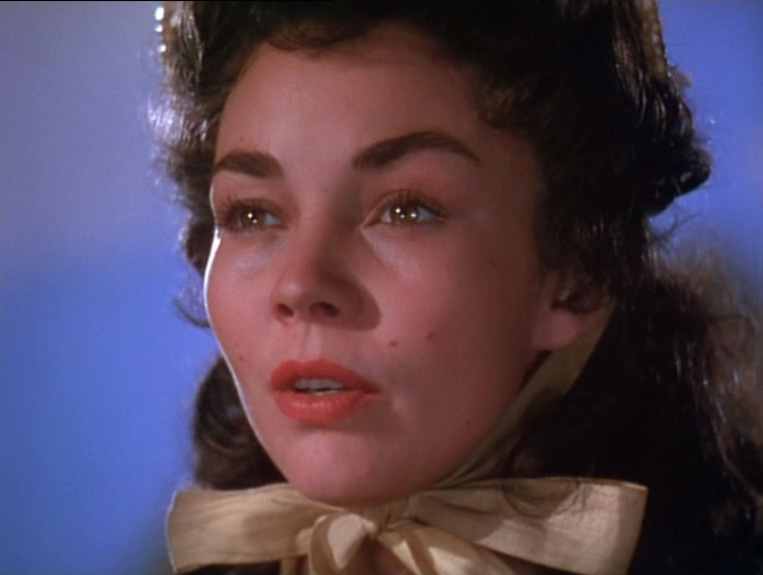
On Thursday 17th December, one of the most cherished of actresses of the 40s and 50s passed away. Her name was originally Phylis Isley, but after fame she became forever known as Jennifer Jones. R.I.P Miss Jones, you will be missed.

In her first starring role, Jennifer receieved an Academy Award for The Song of Bernadette (1943), and she went onto have an unbeatable track record for the rest of the forties, raking up three more nominations. Some of the highlights of the decade that I've seen include:

Since You Went Away - when she sends off boyfriend Robert Walker to war it's one of the most haunting scenes committed to screen; and later when she gives Agnes Moorehead one of the best verbal backhands, it's purely awesome.

Love Letters - Jones shows here that she can work well in psychological dramas. She's bright and wide-eyed, yet has repressed emotions that time will reveal. She was nominated for the third time here.

Cluny Brown - Jennifer Jones proves she can do comedy, and with no less than legendary Ernst Lubitsch at the reigns. Jones' Cluny Brown is a delightful plumber to be who finds her eccentric equal is in Charles Boyer.

Duel in the Sun - Apparently this was controversial in its time, and it makes sense since this is one western that's just spilling over with sex appeal. Jones and Gregory Peck make quite a passionate couple in this.

Portrait of Jennie - Probably Jones' best film and performance (so far), this is one of the most enigmatic films I've ever seen. It has such a fantasy setting and Jones graduates from youngster to mature woman in every second or third scene. Jones' indomitable charm and optimism makes this one of her most memorable films.

Other apparent notables that I am yet to see are: her oscar-winning turn in The Song of Bernadette and the Vincente Minnelli directed Madame Bovary. I eagerly await seeing both.

Jones continued building her impressive filmography in the fifties, which culminated in her final Oscar nomination for Love is a Many-Splendoured Thing. Some of the disappointing aspects of the decade were that two of her films with notable directors were butchered by her partner and producer David O'Selznick. Luckily, the originals still exist. I've only seen two of Jones' fifties films and they were both great.

Gone to Earth - This was a Powell-Pressburger film that was eventually re-edited by O'Selznick and turned into The Wild Heart. Luckily I was able to find the original at my university. Jones proved to be stunning in technicolour (see: Duel in the Sun) and even though she is passed thirty in this, you just can't tell. She continued to play the ingenue perfectly and blended her naivety with sex appeal so well. It's a quirky film as only the Archers can pull off and Jones' sometimes enigmatic presence proves to work here.

Carrie - One of the most effective films I've seen this year, to me it's rather cynical and certainly not your typical love story. Laurence Olivier and Jones are at the centre of this film and they prove to have a nice chemistry, which is predominately why the film pulls at your heartstrings so much. Again, Jones plays a young woman and as she often could, she transitions herself from innocence to experience with a grace that is all her own.

Other apparent notables that I'm yet to see: Vittorio De Sica's Stazione Termini, Beat the Devil with Humphrey Bogart (where she dons a blonde wig), the Oscar nominated Love is a Many-Splendored Thing, Good Morning Miss Dove, and a re-teaming with Gregory Peck in The Man With the Grey Flannel Shirt.

The sixties was more toned down for Jones, and she appeared in three films: Tender is the Night, The Idol and Angel, Angel Down We Go.

Jones ended her career with an all-star cast in The Towering Inferno. I haven't seen it, but with such stars on board (Paul Newman, Steve McQueen, Faye Dunaway, Fred Astaire), it's not a bad way to finish such a stunning film career.

Jennifer Jones, you were a marvel on screen. You were somewhat of a predecessor for wide-eyed fifties ingenues like Audrey Hepburn and Jean Simmons. But, of course, you were unique and your characters were all your own. You had an adorable lisp and were stunning to behold. On top of all that, you created some of the most memorable characters of celluloid. Rest in peace.

Thursday, December 17, 2009

A Review: Avatar (2009)

I haven't really been reviewing films I've seen at the cinema (with the exception of a mini one of 500 Days of Summer), but I felt I'd just give out three cheers to Avatar, now that it's still fresh in my mind.

I first heard of the film late last year because of some boards on imdb (it always comes back to imdb...) concerning the most anticipated films of 2009. Well, as is sometimes the case for me, I didn't really give two hoots about Avatar then. A few things would have to happen before I bought into the hype: first a friend of mine from cinema studies showed me the trailer, and yes it looked interesting. But the aspect of the film that really got me hook, line and sinker was the film's rising star, yes Sam Worthington. He appeared on Rove and his story about his struggles in his career and the fact that James Cameron plucked him out of obscurity kind of grabbed me. Soon Sam Worthington becomes my current actor crush (God I haven't had one of those in so long) and his face seems to appear everywhere. So I watched the trailer again and I became as excited as ever for the film's release. This was a few weeks back.

Now it's Thursday 17th of December, and I can safely say in my current mindset, the film is worth the price of admission. Objectively, as a friend pointed out afterwards, the plot structure is kind of predictable in that it takes the path of most Hollywood narratives - conflict/resolution. And that's not so bad, only that the writing sometimes draws attention to its formula. Not that this ruins the film, hardly. The only other issue I had with the film is that it was quite long. My left arm ached so much.

But that was because I didn't want to move it. I was pretty enthralled throughout the film. I mean generally I have to move around in my seat when I'm watching any film. I moved once this time (I'm pretty sure). There's just something about James Cameron's Avatar that works for me. I like the story - ex-marine in a wheelchair joins a crew to the planet Pandora in order to exploit the land from the natives. He is one of three who turns themselves into these natives - three feet and blue-skinned, quite a marvel - through a machine called an avatar. It's their job to gain the native's trust to make the mission easier. Only Jake Sully, the ex-marine (Sam Worthington) becomes so embroiled in becoming a native that he finds his sympathies lying with them. And you can understand his love - Pandora is this beautiful, natural place where there's a deep ecology happening, humans are one with all other living beings around them. He's wary of all this 'tree-hugging' behaviour at first, but then he understands the connections to nature that humans have long ago forgotten. On this level Avatar is quite significant in today's age.

Of course, Avatar is also an action-adventure film and I'll say, for someone who doesn't leap out of their way for these sorts of films, I loved the suspense-filled sequences. I was quite into them, invariably displaying tears, excitement and horror. I can't imagine the painstaking effort taken to make the film what it is, and I won't try to. I'll only say that it's a visual treat to see this film and I only wish I had seen it in 3D, but alas, in its 2D format it's still grand.

Superlatives are dangerous to use, as I'm probably blowing up the film out of proportion. It's suffice to say that I enjoyed it, and I went into it knowing the hype. It's entertaining, exciting and makes you think and feel. What else is necessary for a good film?

Tuesday, December 15, 2009

Awards Season

For the first time in my little life I am going to follow the buzz around the Oscars and try to predict winners or put in two cents on what films/performances deserve acclaim. It's all happening because I was on imdb a little while ago and on the classic film board there's a thread on all these critics awards. And from that thread I deciphered that the biggest buzz has been surrounding such films as [mind you I haven't seen any of these--yet--except Up]:

Avatar [there's a big popularity generating around this film in general]**seen it
An Education [I've been really wanting to see this]
The Hurt Locker [Kathryn Bigelow might become the first female director to win an Oscar]
Invictus [Clint Eastwood directed, so I'm there]
Nine
Precious
A Single Man

Up**seen it
Up in the Air
**seen it

...Otherwise there are some names frequently popping up for their acting: Jeff Bridges for Crazy Heart, Meryl Streep for Julie and Julie, Mo'Nique for Precious, Christoph Waltz for Inglourious Basterds [though I don't think I'll be watching this with its bloodshed...]

None of this means much now, but hopefully in the coming months I'll be posting thoughts as I watch more films...

On the other hand, the idea of this might fizzle out. It's all pretty unpredictable from here.

Monday, December 14, 2009

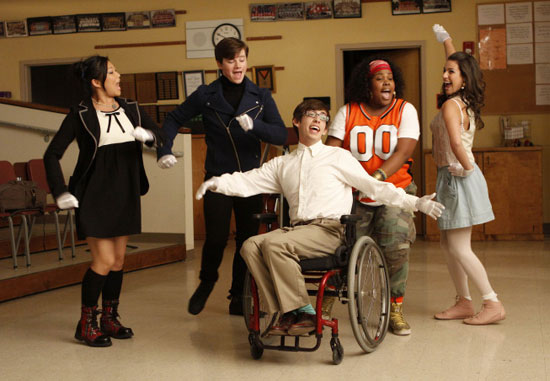
Glee Completes Me

The last episode of the first season of Glee aired in Aus yesterday and true to all last episodes, it left me wanting more.

I'm almost certain I could watch the ups and downs of the Glee Club at McKinley High all day and not get bored. I might try it when the dvd comes out. All this even though my first taste of Glee wasn't exactly sweet.

From the pilot episode I decided that Glee was too stereotype-riddled and saccharine to be likeable. The only good points I picked up was the sharp and deadly wit of Sue Sylvester. Even though I like musical-filled shows/films, the songs here didn't immediately grab me. They felt too 'high school musical'.

Weird things happened the more I watched. I was actually engaged by the Quin pregnancy storyline (and even moreso when it turned out Puck was the dad) and just as hooked on Mr. Shue and Terri's 'baby' storyline. I was still a little huffy at the stereotypes: why were the blondes unlikeable? Why was Rachel so self-centred? Finn's a ditz, Kurt's kinda flamboyantly gay (but he is lovely), Puck's a bad boy. It's sometimes hard to like characters if they're two-dimensional, and yet the more of Glee I see, the more hooked on these characters I get.

And there's more. I know that Emma is probably best for Mr. Shue, there's obvious reasons to ship them as a couple - she understands him, respects him, adores him. His wife, in comparison, is so self-centred. But maybe Terri's just misunderstood and Emma's not as sweet as she seems to be. It'll be up to the writer's to see how this triangle continues to unravel itself.

One of the biggest drawcards of a show like Glee is the music - they're basically all covers (maybe there are a few written for the show, I don't know), but they're nicely done, in spite of the pop overfill. The kids have a great energy and look like they're really enjoying themselves and that's of bigger importance than anything else. The show has some nice moments of friendship, teamwork, believing in yourself and sticking it out no matter what. Kind of cheesy, yes, but Glee has an indescribable vibrance about it that distinguishes itself from other teen-directed shows out there.

The test now is, will Glee be able to keep it? Will it give out too much too soon? Will it give too little? And will Sue bring on the works as she promises and keep producing hurdles for Glee?

Here's hoping that the second season will be as good as the first!