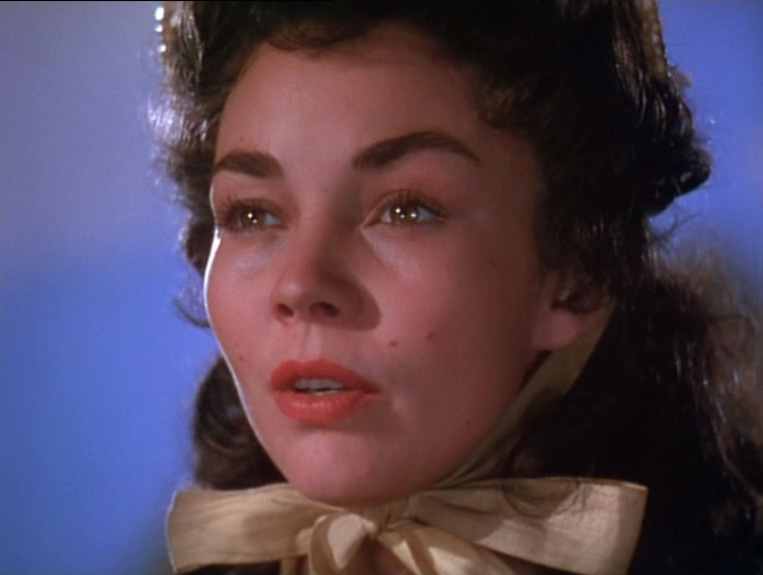
On Thursday 17th December, one of the most cherished of actresses of the 40s and 50s passed away. Her name was originally Phylis Isley, but after fame she became forever known as Jennifer Jones. R.I.P Miss Jones, you will be missed.
In her first starring role, Jennifer receieved an Academy Award for The Song of Bernadette (1943), and she went onto have an unbeatable track record for the rest of the forties, raking up three more nominations. Some of the highlights of the decade that I've seen include:
Since You Went Away - when she sends off boyfriend Robert Walker to war it's one of the most haunting scenes committed to screen; and later when she gives Agnes Moorehead one of the best verbal backhands, it's purely awesome.
Love Letters - Jones shows here that she can work well in psychological dramas. She's bright and wide-eyed, yet has repressed emotions that time will reveal. She was nominated for the third time here.
 Cluny Brown - Jennifer Jones proves she can do comedy, and with no less than legendary Ernst Lubitsch at the reigns. Jones' Cluny Brown is a delightful plumber to be who finds her eccentric equal is in Charles Boyer.
Duel in the Sun - Apparently this was controversial in its time, and it makes sense since this is one western that's just spilling over with sex appeal. Jones and Gregory Peck make quite a passionate couple in this.
Portrait of Jennie - Probably Jones' best film and performance (so far), this is one of the most enigmatic films I've ever seen. It has such a fantasy setting and Jones graduates from youngster to mature woman in every second or third scene. Jones' indomitable charm and optimism makes this one of her most memorable films.
 Other apparent notables that I am yet to see are: her oscar-winning turn in The Song of Bernadette and the Vincente Minnelli directed Madame Bovary. I eagerly await seeing both.
Jones continued building her impressive filmography in the fifties, which culminated in her final Oscar nomination for Love is a Many-Splendoured Thing. Some of the disappointing aspects of the decade were that two of her films with notable directors were butchered by her partner and producer David O'Selznick. Luckily, the originals still exist. I've only seen two of Jones' fifties films and they were both great.
Gone to Earth - This was a Powell-Pressburger film that was eventually re-edited by O'Selznick and turned into The Wild Heart. Luckily I was able to find the original at my university. Jones proved to be stunning in technicolour (see: Duel in the Sun) and even though she is passed thirty in this, you just can't tell. She continued to play the ingenue perfectly and blended her naivety with sex appeal so well. It's a quirky film as only the Archers can pull off and Jones' sometimes enigmatic presence proves to work here.
 Carrie - One of the most effective films I've seen this year, to me it's rather cynical and certainly not your typical love story. Laurence Olivier and Jones are at the centre of this film and they prove to have a nice chemistry, which is predominately why the film pulls at your heartstrings so much. Again, Jones plays a young woman and as she often could, she transitions herself from innocence to experience with a grace that is all her own.
 Other apparent notables that I'm yet to see: Vittorio De Sica's Stazione Termini, Beat the Devil with Humphrey Bogart (where she dons a blonde wig), the Oscar nominated Love is a Many-Splendored Thing, Good Morning Miss Dove, and a re-teaming with Gregory Peck in The Man With the Grey Flannel Shirt.
The sixties was more toned down for Jones, and she appeared in three films: Tender is the Night, The Idol and Angel, Angel Down We Go.
Jones ended her career with an all-star cast in The Towering Inferno. I haven't seen it, but with such stars on board (Paul Newman, Steve McQueen, Faye Dunaway, Fred Astaire), it's not a bad way to finish such a stunning film career.
Jennifer Jones, you were a marvel on screen. You were somewhat of a predecessor for wide-eyed fifties ingenues like Audrey Hepburn and Jean Simmons. But, of course, you were unique and your characters were all your own. You had an adorable lisp and were stunning to behold. On top of all that, you created some of the most memorable characters of celluloid. Rest in peace.